01
Neural core
Low-latency scheduling for agent runs, queues, and priority shifts on your metal.
Deploy, connect, and manage AI agents across your infrastructure — with built-in isolation, mesh networking, and operator tooling in one surface.
Directional labels, not benchmarks. See project docs for what ships today.
Stand up control plane, Postgres, Redis. Compose profiles match your environment in Getting Started.
Define agents, models, capabilities; import from trusted registries when you enable marketplace paths.
Federate instances, turn on mesh features, and route GPU-heavy tiers without a second orchestrator.
Trusted by teams shipping agents in production
See it in action
Vertical integration spectrum [01–09]
Sys status: optimal · landing
Low-latency scheduling for agent runs, queues, and priority shifts on your metal.
Discovery and signed traffic between instances: local bus today, federation where you enable it.
Noise sessions, SPIFFE-ready identity, and policy hooks so trust stays explicit.
Postgres + pgvector and shared state patterns agents can query without ad-hoc glue.
Backpressure and multi-tenant fairness so bursts don’t flatten the whole fleet.
OpenTelemetry-shaped events: traces, metrics, and operator-facing narratives in one pipe.
Short-lived credentials and capability scopes for subprocesses and tools.
Secrets and keys bound to workload identity, not copy-pasted env files.
Operator surface for bootstrap, health checks, and automation against your deployment.
Free · Self-hosted · 5 min setup
Local install
From checkout — no outbound forge required
No forge links: work from checkout or release archive. Full mesh / prod / marketplace docs: /docs and in-tree docs/.
Generate a real ENCRYPTION_KEY (64 hex chars) before prod.
# Database (example — match your Compose)
DATABASE_URL=postgres://pilox:pilox_secret@localhost:5432/pilox
AUTH_SECRET=change-me-to-at-least-32-characters-long
AUTH_URL=http://localhost:3000
ENCRYPTION_KEY=0000000000000000000000000000000000000000000000000000000000000000
REDIS_URL=redis://localhost:6379
ADMIN_PASSWORD=changemeRequires Node ≥ 22 and Docker for the default database profile.
# From repository root
cd app
docker compose up -d postgres redis
npm install
npm run db:migrate:run
npm run db:seed
npm run dev
# Open http://localhost:3000 → /setup then /auth/loginFrom the docker/ directory in your tree — no remote clone step.
cd docker
cp .env.example .env
# Edit .env (domain, secrets, Postgres, Redis…)
docker compose -f docker-compose.prod.yml up -d
See docs/SERVER_INSTALL.md and docs/PRODUCTION.md for TLS, domains, and hardening.
Operating context
When agents leave the notebook, they inherit the same obligations as any production workload: isolation, identity, and an evidence trail.
How teams describe the shift to fleet-scale agents
Boundary
One process, many tools, opaque side effects. Pilox treats each agent as a bounded workload with its own execution envelope.
Trust
Not just API keys: signed manifests, federation-aware policy, and mesh discovery you can put in front of security review.
Scale
The same control plane semantics locally and across peers: bus, federation, then planetary registry paths without re-architecting your mental model.
Platform
Everything below maps to components you can deploy, audit, and extend, not a slide-deck feature list.
Firecracker microVMs per agent where KVM is available; WASM path for density. Docker Compose stacks for Postgres, Redis, Ollama, and the control plane: same primitives serious infra teams expect.
~125ms
VM cold path
9
Stack layers
BSL→ASL
2030 path
Execution
MicroVM isolation + WASM density
Firecracker-class boundaries where the hypervisor exists; WASM path when you need cold starts measured in milliseconds.
Wire protocol
A2A + MCP as first-class surfaces
Agent Cards, streaming RPC, and MCP tool exposure, not bolt-on plugins after the fact.
Mesh
Local bus → federation → registry
Redis v1 with integrity, then signed cross-instance trust, then discovery documents the network can crawl.
Layered model: isolation, zero-trust networking, sanitization, guardrails (LLM Guard, LlamaFirewall, NeMo), capability-style least privilege, audit-oriented event chains.
Operator dashboard, marketplace catalog from federated registries, OpenTelemetry hooks, GPU scheduling hooks (MIG / HAMi) as you scale hardware.
Native A2A (JSON-RPC, streaming, Agent Cards) and MCP for tools. @pilox/a2a-sdk direction: Noise E2E, SPIFFE-aware identity, schema enforcement, standard-compatible and security-first.
Redis bus v1 with HMAC integrity locally; signed manifests and JWT (Ed25519) across instances; registry, gateway, and WAN path for planetary discovery via /.well-known/pilox-mesh.json.
Depth
Roadmap and vision vary by release. Use these as design anchors when you read the repo.
Global mesh
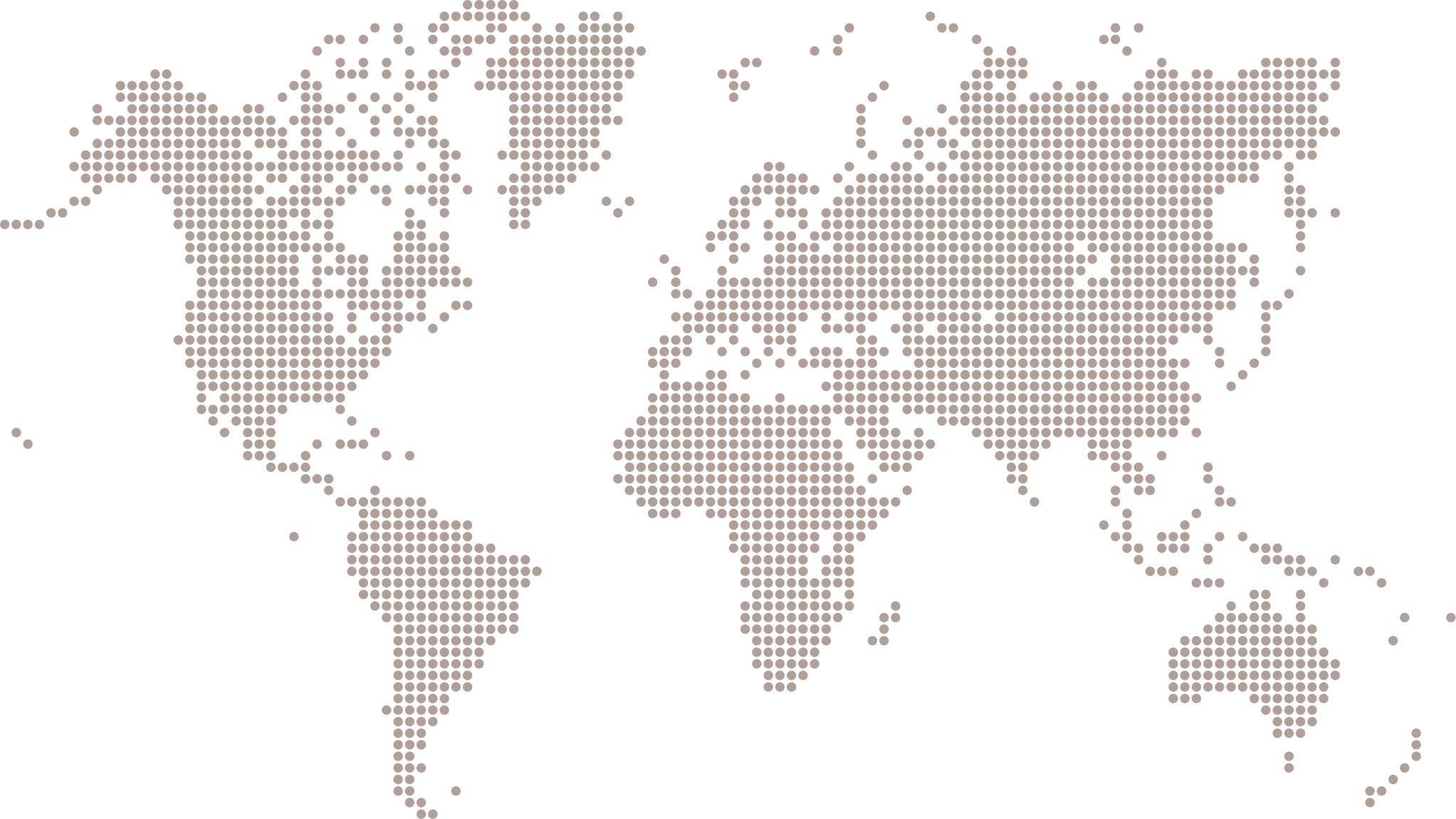
Pilox connects agents across regions the way operators think about infrastructure: a local bus, federated trust, then registries and gateways at the edge. The map is illustrative topology — not live telemetry or cable geography.
Federation & registry paths — phased rollout
Redis bus v1 on your cluster: fast pub/sub with HMAC integrity for co-located agents.
Trusted peers exchange signed manifests and JWT (Ed25519) so instances trust each other, not the whole internet.
Registry, gateway, and WAN bridges discover routes via /.well-known/pilox-mesh.json (phased rollout, same mental model).
Comparison
Pilox is the only self-hosted agent OS with A2A federation, visual workflows, and a built-in marketplace — no glue code required.
| Feature | Pilox | LangChain | CrewAI | AutoGen |
|---|---|---|---|---|
| Self-hosted (your VPC) | ||||
| A2A protocol (LF standard) | ||||
| MCP support | ||||
| Federated mesh | ||||
| Built-in marketplace | ||||
| Workflow engine (visual) | ||||
| Multi-model (Ollama, OpenAI, etc.) | ||||
| GPU routing | ||||
| Observability (Prometheus + Tempo) | ||||
| No vendor lock-in |
Community free · Pro 29€/mo · Enterprise custom
Architecture
Neural-mesh topology: each node runs independently under collective Pilox control-plane logic. The ladder is the map; the accordion is the briefing — L0 through L8, repo is source of truth.
Stack preview
Pilox global catalog
Static JSON shipped with the landing. Instances merge the same file via PILOX_GLOBAL_CATALOG_URL.
Marketplace
Federation is not a CSV export: it is policy, signatures, and a path from catalog to running workload inside your perimeter.
Read docs/MARKETPLACE_ARCHITECTURE.mdFlow
01
Discover
Browse federated catalogs; filter by policy, capability, and registry origin.
02
Validate
Buyer checklists and signed manifests before anything touches your namespace.
03
Deploy
Promote into your instance with local stats and pins your operators actually use.
Catalog grid
Placeholder for agent cards, filters, and deploy actions once marketing assets ship.
Ecosystem
Curated slices below; the ticker is the full integration surface.
Evaluation
Procurement and platform teams rarely compare on marketing pages alone. This table is a starting point for your own RFP rows and vendor questionnaires.
| Capability | Pilox | Typical stack |
|---|---|---|
| Self-hosted | Yes (BSL 1.1) | Varies |
| Agent isolation (microVM) | Firecracker + WASM (roadmap) | Rarely |
| A2A protocol (LF standard) | Native | Uncommon |
| MCP support | Native | Some |
| E2E encryption (Noise) | SDK / mesh path | Rare |
| Zero-trust identity (SPIFFE) | Roadmap / integration | Rare |
| 70B on consumer GPU (VPTQ+TurboQuant) | Yes (2-bit weights + 3-bit KV) | No |
| GPU fractional scheduling | MIG + HAMi (ops) | Rare |
| Planetary mesh / federation | Yes (phased) | No |
| Confidential computing (TEE) | Vision | No |
| Agent marketplace | Built-in direction | Some |
| Anti prompt-injection (layered) | Yes (config-dependent) | Partial |
| Swarm intelligence patterns | Multiple patterns | Graph/crew only |
| Audit trail (hash-chain) | Planned | Rare |
| Web dashboard | Yes | Varies |
| LLM optimization (VPTQ/TurboQuant/sleep) | Yes | Rare |
Security
Least-agency for automated workloads: grant the minimum autonomy an agent needs, instrument the rest.
Agents receive no latent permissions by default. Access is ephemeral, scoped, and verified each cycle — the core posture for anything that runs unsupervised on your estate.
Identity and workload attestation align with how you already bind trust: TPM / Secure Enclave paths, SPIFFE-ready meshes, and keys that do not live in plaintext chat logs.
MicroVM and WASM paths, zero-trust networking between workloads, OPA-style policy hooks where you wire them.
Ed25519 and Noise sessions, optional SPIFFE/SPIRE, short-lived credentials, aligned with how mesh traffic is actually secured.
Structured events suitable for audit pipelines; hash-chained trails and optional external anchoring on the roadmap.
Install
Paths differ by profile. This is the production-oriented entrypoint; adjust compose file per Getting Started.
cd docker
cp .env.example .env
docker compose -f docker-compose.prod.yml up -d
Next: docs/GETTING_STARTED.md in your tree.
Commercial
Start on the open core. Engage commercially when you resell hosted Pilox or need enterprise-grade support around your deployment.
Default path
Free
In development
Soon
For regulated teams
Custom
Changelog
Full rebrand from Hive to Pilox. New design system, Stripe billing, 16-agent marketplace catalog, and enhanced workflow engine.
6-step onboarding with Firebase license verification. Auto-configured local Planetary registry on first boot.
Pro plan at 29/mo with Stripe Checkout. Automatic license upgrade via webhook on payment.
60+ security fixes across both Landing and Docker. AES-256-GCM token encryption, rate limiting, OWASP hardening.
Federated agent mesh with NATS transport, JWT authentication, WAN bridge, and distributed registry.
Community
Pilox is built in the open. Contribute, report issues, or just say hi.
Roadmap
Each row is a theme you can reason about: outcomes first, tech tags second. No month-by-month dates: order is directional, not a delivery promise.
Control plane, embeddings, and identity baselines so agents are observable and attributable from day one.
70B models on consumer GPUs, denser runtimes, and safer prompts: VPTQ + TurboQuant for extreme compression, WASM where it fits.
Kernel-adjacent enforcement and centralized authz, fewer blind spots as fleets grow.
GPU paths, confidential workloads, and autonomy guardrails without a second orchestrator.
Research-grade reliability and economics: WAN-native routing and hardware trends baked into the model.
Phases P1–P6 are described in the mesh product doc (not a delivery calendar).
Cross-Internet discovery and trust: registries, gateways, and WAN bridges, from Redis bus toward planetary routing.
Full mesh breakdown: see Mesh and docs/MESH_PLANETARY_PRODUCT.md in your distribution.
Enterprise
Whether you need a commercial license for a hosted offering, onboarding for a multi-team rollout, or a security questionnaire filled against a specific commit. Start with context in the form.
Direct
contact@maxence.design